
By Orion SEO Team
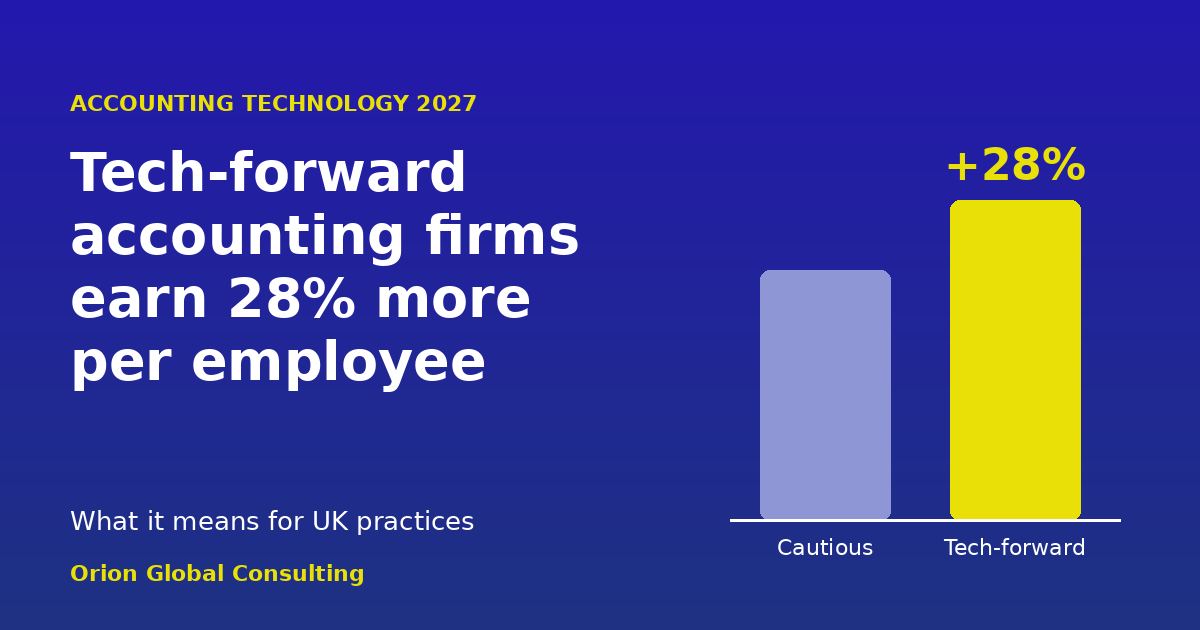
New research from practice management platform Karbon puts a number on something many accounting firm owners already suspect: the firms that adopt technology early are pulling away from the rest. According to Karbon’s State of Technology in Accounting 2027 report, a typical tech-forward firm generates 28% more revenue per employee than a more cautious one. Accountex Insight covered the findings this week, and they deserve a closer look from every UK practice planning for 2027.
Here is what the data says, what it means for UK firms, and the practical steps we recommend to the accounting practices we work with.
The headline numbers
The report draws on more than 1,200 survey responses collected over two years. Karbon splits firms into “progressive” practices, which adopt new technology early or as soon as its value is proven, and “cautious” practices, which wait until a tool becomes the established standard.
- 28% more revenue per employee at a typical tech-forward firm compared with a cautious one.
- +9.5% vs 0%: among firms surveyed in both years, revenue per employee rose 9.5% at progressive firms and was flat at cautious ones.
- 86.7% of firms now use at least one AI tool.
- 17.7% more revenue per employee at firms using AI agents to add capacity, compared with firms adding capacity without them.
- 16.5 tools and 7.2 functions run through practice management at early adopters, against 10.3 tools and 3.1 functions at late adopters.
The gap is widening, not closing
The most important figure is not the 28% itself but the trend behind it. Progressive firms grew revenue per employee by almost a tenth in a single year, while cautious firms stood still. That is a compounding advantage: the firms that invest in systems free up time, take on more clients with the same team, and reinvest the margin into better technology and better talent.
For a cautious practice, “waiting until it’s proven” now carries a real cost. Every year spent on the sidelines widens the productivity gap with competitors who are bidding for the same clients.
AI is everywhere, but used very differently
With nearly nine in ten firms using some form of AI, simply “having AI” is no longer a differentiator. Almost half of firms access AI through software they already own, and the vast majority of those also use frontier models such as ChatGPT, Claude or Gemini directly.
The difference between leaders and laggards is how deeply AI and automation are woven into the way the firm runs. Early adopters centralise far more of their work, from client onboarding and workflow to billing and communication, inside one practice management system. Last year only 23.3% of firms using practice management software ran five or more functions through it. This year it is 63.2%.
AI agents: adding capacity without adding payroll pressure
The report also looks at how firms add capacity. Around 40% of firms that are growing their capacity now use AI agents alongside hiring and outsourced work, rather than instead of them. Those firms generate 17.7% more revenue per employee. With payroll at around 45% of revenue for both groups, the gain comes from each person producing more, not from cutting staff.
For UK practices facing a tight talent market and pressure on fees, that is the most encouraging finding in the report: AI is a lever for growth, not a threat to the team.
What this means for UK accounting firms
Karbon’s revenue figures are reported for US firms, so UK practices should treat them as a direction of travel rather than a precise benchmark. But the pattern matches what we see across the UK accounting firms we support. The practices growing fastest have stopped treating technology, marketing and operations as separate projects. They run them as one growth system.
There is also a side of being “tech-forward” that most surveys do not measure: how visible and modern a firm looks to the clients it wants to win. A practice can automate its back office and still lose new business because its website does not appear on Google, in Google’s AI Overviews or in ChatGPT answers when a business owner searches for an accountant. Tech-forward firms apply the same thinking to client acquisition, using SEO services for accountants, automated follow-up and a CRM that captures every enquiry.
A five-step plan to become a tech-forward firm
- Audit your stack. List every tool the firm pays for and every task still done by hand or in spreadsheets. Most firms find duplicate tools and obvious gaps within an hour.
- Centralise in one system. Move onboarding, workflow, client communication and billing into your practice management platform wherever possible. The data shows this is where early adopters pull ahead.
- Give AI specific jobs. Start with repeatable, measurable work: drafting client emails, summarising meetings, preparing first drafts of reports or chasing missing records.
- Modernise how clients find you. Make sure your website loads fast, targets the services and locations you want to grow in, and is structured so AI search tools can cite it.
- Measure revenue per employee. Track it quarterly. It is the clearest single number for telling whether your technology investment is paying off.
Frequently asked questions
What is a tech-forward accounting firm?
A tech-forward (or progressive) firm adopts new technology early or as soon as its value is proven, rather than waiting until it becomes the industry standard. In Karbon’s research these firms earn 28% more revenue per employee than cautious adopters.
Will AI replace accountants?
The evidence points the other way. Firms using AI agents add capacity alongside hiring rather than replacing it, and their payroll as a share of revenue is almost identical to other firms. AI raises what each person can deliver.
Where should a small practice start?
Start with one practice management system and one or two clearly defined AI tasks, then fix how new clients find you online. Small, measurable changes compound quickly.
Ready to grow like a tech-forward firm?
Orion Global Consulting helps accounting firms across the UK and internationally build AI-first growth systems, from SEO and AI search visibility to CRM automation and lead generation. Book a consultation to see where your firm stands.
Sources: Karbon, The State of Technology in Accounting 2027 (October 2026); Accountex Insight; Karbon.
Reviewed by PhD. Orjona Fjerza, Founder & CEO, Orion Global Consulting