

By Orion SEO Team
If you’re planning a new website, one of the first decisions is what kind of website you need. Developers talk about “static”, “dynamic” and “e-commerce” sites, and the choice affects your budget, speed, security, SEO and how easily you can update your content.
This guide explains what a static website is, what a dynamic website is, what makes an e-commerce website different, and how to choose the right option for your business.
What is a static website?
A static website is made up of fixed pages. Each page is a pre-built file (usually HTML, CSS and JavaScript) that is delivered to every visitor exactly as it was created. Nothing is generated on the fly, and every visitor sees the same content.
To change a static page, a developer edits the file and uploads it again. Static sites can also be built with modern “static site generators” and hosted on fast content delivery networks.
Examples of static websites
- A brochure site for a local business with Home, About, Services and Contact pages
- A single-page landing page for a campaign or event
- A portfolio or CV website
- Product documentation or a simple information site
Advantages of a static website
- Very fast: pages load quickly because nothing needs to be built on the server.
- Secure: no database and fewer moving parts means fewer points of attack.
- Low cost: cheaper to build and host.
- SEO-friendly: speed and clean code support good Core Web Vitals.
Disadvantages of a static website
- Updates usually need a developer, unless a headless CMS is added
- No user accounts, bookings, personalised content or built-in search
- Harder to manage as the number of pages grows
What is a dynamic website?
A dynamic website builds its pages when someone visits them. Content is stored in a database and pulled together by server-side code (for example PHP, Node.js or Python), so pages can change depending on who is viewing them, what they searched for, or the latest content you’ve published.
Most dynamic websites run on a content management system (CMS) such as WordPress, Drupal or a custom platform. That means you can add pages, blog posts and images yourself without touching code.
Examples of dynamic websites
- Business websites with a blog or news section, such as the one you’re reading now
- Membership sites, client portals and online courses
- Booking systems for salons, clinics, restaurants and consultants
- Social networks, forums and web applications
Advantages of a dynamic website
- Easy to update: edit content through a simple dashboard.
- Interactive: forms, logins, search, bookings and personalised content.
- Scales with your business: add hundreds of pages or posts easily.
- Great for content marketing: publish blogs and guides that build SEO over time.
Disadvantages of a dynamic website
- Needs regular updates, backups and security maintenance
- Can be slower without caching and good hosting
- Usually costs more to build and run than a static site
What is an e-commerce website?
An e-commerce website is a specialised type of dynamic website built to sell products or services online. As well as normal pages, it includes a product catalogue, shopping basket, secure checkout, payment processing, stock management, order tracking and customer accounts.
Popular e-commerce platforms include Shopify, WooCommerce (built on WordPress), Magento (Adobe Commerce) and BigCommerce. Larger businesses sometimes choose a custom or headless build for more flexibility.
Key features of an e-commerce website
- Product and category pages with images, prices and variations
- Basket and secure checkout with card, Apple Pay, Google Pay or PayPal
- Stock, shipping and tax (VAT) settings
- Customer accounts, order history and email notifications
- Discount codes, reviews and integrations with marketplaces and Google Shopping
Because an online shop handles payments and personal data, security, SSL, GDPR compliance and PCI-compliant payment providers are essential. If you’re planning a store, see our e-commerce website development service.
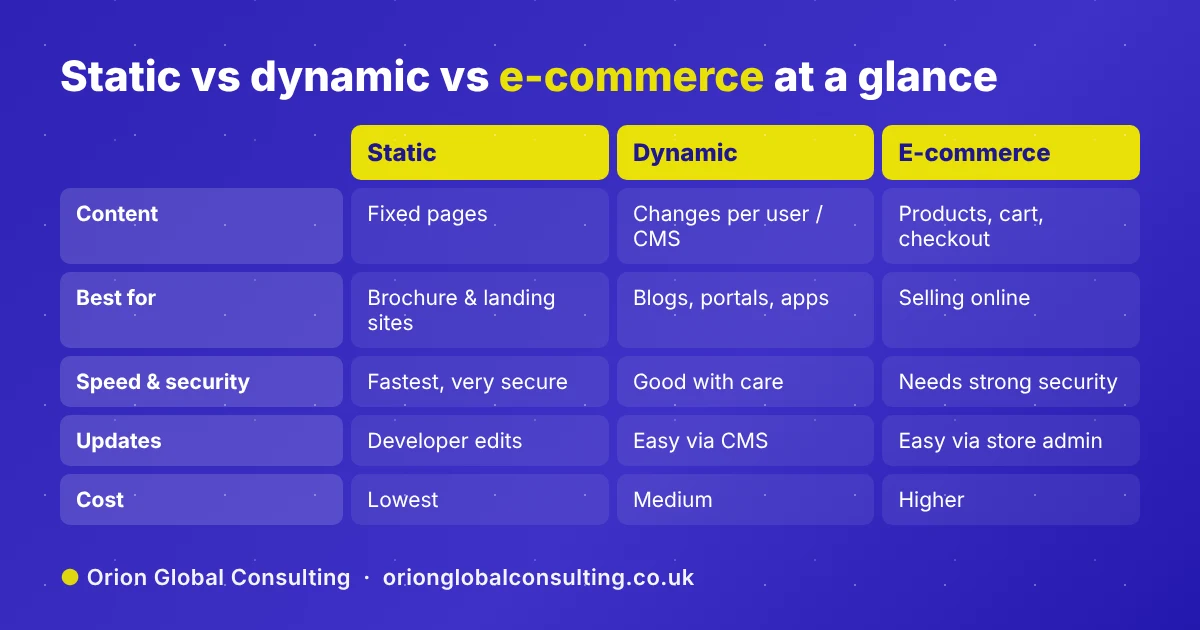
Static vs dynamic website: the key differences
- Content: static pages are fixed; dynamic pages are generated from a database.
- Updating: static sites usually need a developer; dynamic sites can be updated through a CMS.
- Speed: static sites are fastest by default; dynamic sites need caching and good hosting.
- Security: static sites have fewer vulnerabilities; dynamic sites need regular maintenance.
- Functionality: dynamic sites support logins, bookings, search and personalisation.
- Cost: static sites are cheaper; dynamic and e-commerce sites cost more but do more.
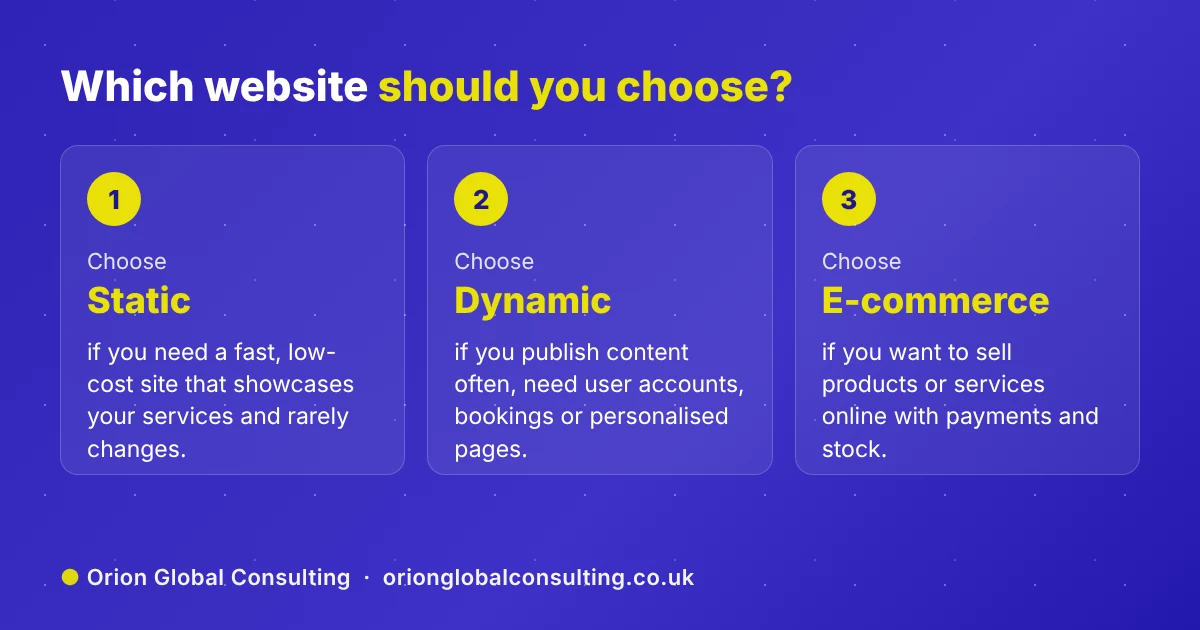
Which type of website should you choose?
- Choose a static website if you need a fast, affordable site that presents your services and won’t change often.
- Choose a dynamic website if you want to publish content regularly, take bookings, offer client logins or grow through content marketing and SEO.
- Choose an e-commerce website if you want to sell products or services online and take payments directly.
Many businesses use a hybrid. For example, a fast static-style front end with a CMS behind it, or a WordPress site with a WooCommerce shop added. The right choice depends on your goals, budget and how you plan to grow.
How website type affects SEO
Any website type can rank well if it is built properly. What matters most is:
- Fast loading and strong Core Web Vitals
- Mobile-friendly design
- Clean URLs, page titles, headings and internal links
- Structured data (schema) such as Organisation, Product and FAQ
- Fresh, helpful content, which is easier to publish on a dynamic site
Static sites have a natural speed advantage. Dynamic and e-commerce sites have the edge for regular content and product pages. Our SEO and AI search optimisation service makes sure your website is set up to rank in Google and get cited in AI answers, whichever type you choose.
How much does a website cost?
Costs depend on the number of pages, features, design and integrations you need. At Orion Global Consulting, websites start from £499, and every project is scoped after an initial consultation so you get the right build for your goals.
Why choose Orion Global Consulting for your website?
- Full-service team: design, development, SEO, content and digital marketing under one roof.
- 100+ clients across 8 countries: from professional services firms to e-commerce brands.
- SEO built in from day one: fast, mobile-first sites structured to rank.
- Every option covered: static sites, WordPress builds, e-commerce stores, plus mobile apps and custom software.
Explore our website development services or browse our portfolio.
Frequently asked questions
What is a static website in simple terms?
A static website is made of fixed pages that show the same content to every visitor. Pages are pre-built files, so they load quickly and are simple to host.
What is a dynamic website in simple terms?
A dynamic website creates pages on demand from a database, so content can change, be personalised or be updated easily through a content management system like WordPress.
Is WordPress static or dynamic?
WordPress is a dynamic CMS. Pages are generated from a database, although caching and static export tools can make WordPress sites behave almost like static sites for speed.
Is an e-commerce website static or dynamic?
E-commerce websites are dynamic. They need databases to manage products, stock, baskets, customer accounts and orders.
Which is better for SEO, static or dynamic?
Both can rank well. Static sites are naturally fast; dynamic sites make it easier to publish fresh content regularly. Good structure, speed and helpful content matter more than the type of site.
Not sure which website is right for you?
Book a 30-minute strategy consultation with our team. We’ll talk through your goals and recommend the right type of website, platform and SEO setup for your business.
Book your strategy consultation | Call 020 8287 4494 | Contact us
Reviewed by PhD. Orjona Fjerza, Founder & CEO, Orion Global Consulting