
By Orion SEO Team
Most UK accounting firms have tried AI by now. A chatbot on the website, a tool that drafts client emails, some automated bookkeeping. Yet many partners tell us the same thing: the tools work on their own, but the firm doesn’t feel any smarter. That is because they bought AI tools without building AI architecture.
This guide explains what AI architecture for accounting firms actually means, why it matters more than any single tool, and how to build it step by step so your practice can grow without adding headcount at the same rate.
What is AI architecture for accounting firms?
AI architecture is the structure that connects your firm’s data, systems, workflows and AI tools so they work as one operating model rather than a set of disconnected apps. Think of it in two layers:
- The architecture layer (the foundation): clean client data, connected systems (practice management, accounting software, CRM, document storage, email), standard workflows, security and governance rules.
- The AI intelligence layer (the outcomes): automation, predictive insights, smart client communication, self-correcting workflows and real-time decision support that sit on top of that foundation.
The simplest way to put it: architecture builds the foundation, AI powers the outcomes. Without the first, the second never delivers what was promised.
Why AI tools alone don’t transform an accounting practice
When AI is added tool by tool, firms usually hit the same problems:
- Client data sits in several places, so AI outputs are incomplete or wrong.
- Each tool needs its own manual hand-off, so staff end up copying and pasting between systems.
- Nobody owns the rules for data protection, accuracy checks or client confidentiality.
- Partners cannot see what is working, so investment decisions are based on guesswork.
An architecture-first approach fixes this by deciding how everything connects before deciding which tools to add. It is the same discipline accountants apply to a client’s chart of accounts: get the structure right and the reporting takes care of itself.
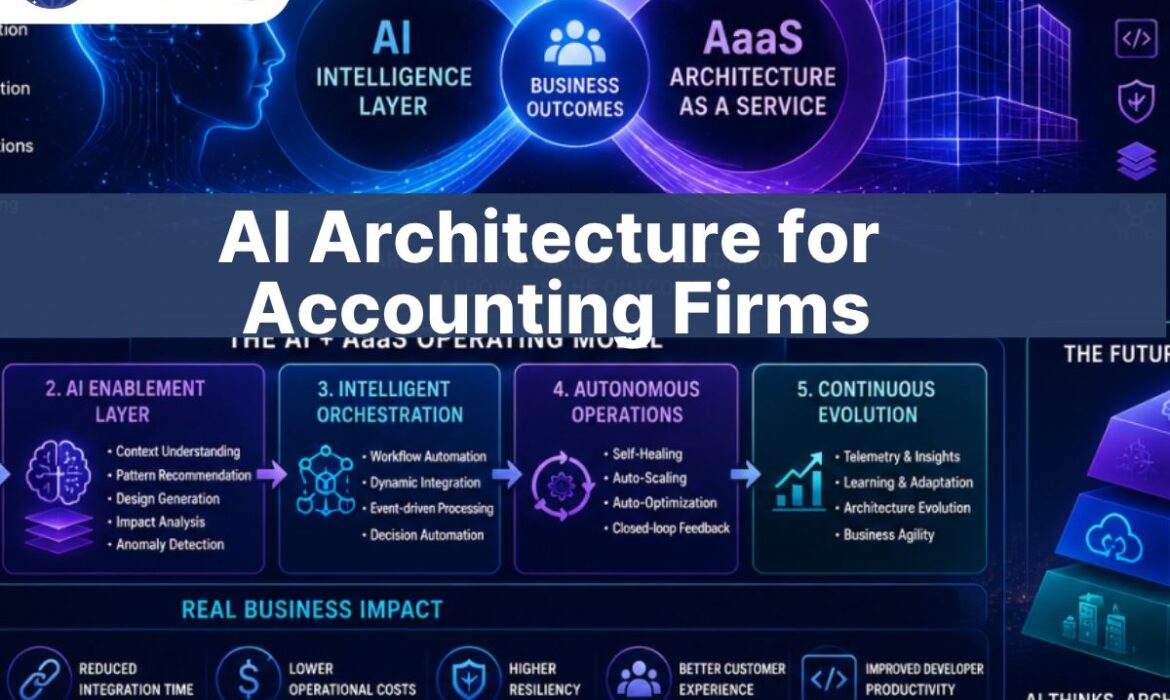
The AI + Architecture-as-a-Service operating model
At Orion Global Consulting we use a five-stage model to move accounting firms from scattered tools to an intelligent, increasingly autonomous practice.
1. Architecture services (the foundation)
Map your systems, data flows and client journey. Standardise reusable building blocks: onboarding templates, engagement letter workflows, document requests, integration points and APIs between your practice management, bookkeeping and CRM platforms. Set governance and security policies aligned with UK GDPR and professional body requirements.
2. AI enablement layer
Prepare your data so AI can use it safely: clean client records, consistent naming, clear permissions. Then connect the AI capabilities that make sense for your firm, such as document reading, data extraction, email triage and knowledge search across your own policies and past advice.
3. Intelligent orchestration
This is where workflows start running themselves. A new client signs up and onboarding, AML checks, document requests and the welcome sequence trigger automatically. A VAT deadline approaches and the right reminders, tasks and reviewer assignments are created without anyone chasing.
4. Autonomous operations
With the foundation and orchestration in place, AI agents can handle routine work end to end, with human review where it matters: categorising transactions, flagging anomalies, preparing first-draft management accounts, answering common client questions and following up on missing records.
5. Continuous evolution
Good architecture is never finished. Performance dashboards show where time is saved, where errors occur and which services are most profitable. The system learns, and the firm keeps improving its workflows, client experience and advisory offer quarter by quarter.
Where accounting firms see the biggest impact
- Faster time to value: new services and automations go live in weeks, because the building blocks already exist.
- Lower operating cost per client: less manual admin across onboarding, compliance and chasing.
- Higher accuracy: data is entered once and flows everywhere, reducing rekeying errors.
- Better client experience: quicker responses, proactive reminders and clearer communication.
- More time for advisory work: the hours freed from compliance can be redirected into higher-value conversations with clients.
- Stronger resilience: the firm is less dependent on individual staff knowing “how things are done”.
AI architecture and growth: the marketing connection
AI architecture is not only an operations project. The same connected data powers your growth engine. When your CRM, website, email marketing and client records talk to each other, you can:
- Route enquiries from your website and Google Business Profile straight into a qualified pipeline.
- Send personalised nurture emails based on a prospect’s sector, size or service interest.
- Spot cross-sell opportunities, such as payroll or advisory, from existing client data.
- Publish clear, structured expertise that answer engines such as ChatGPT, Gemini and Google AI Overviews can quote. Read our guide on AEO vs SEO for UK accounting firms to learn more.
For practical starting points, see AI automation for accounting firms: 7 workflows to automate first and AI marketing for accountants.
A practical roadmap: building AI architecture in 90 days
- Weeks 1–3: Audit and map. List every system, data source and manual hand-off. Identify the five most time-consuming repetitive tasks.
- Weeks 4–6: Design the foundation. Agree a single source of truth for client data, integration points, permissions and governance rules.
- Weeks 7–9: Automate the first workflows. Start with onboarding, document collection and deadline reminders, where the return is quick and visible.
- Weeks 10–12: Add intelligence and measure. Introduce AI assistants for triage and drafting, set up a performance dashboard and plan the next quarter.
Common mistakes to avoid
- Buying tools before defining the architecture. You end up with overlapping subscriptions and no joined-up view.
- Ignoring data quality. AI is only as reliable as the client data underneath it.
- Removing human review too early. Keep qualified accountants in the loop for anything that affects tax, compliance or client advice.
- Treating it as an IT project. AI architecture changes how the firm works, so partners and team leads need to own it.
- No measurement. If you cannot see the hours saved and the revenue gained, you cannot prioritise the next step.
How Orion Global Consulting helps accounting firms
Orion Global Consulting is an AI-first digital marketing and business strategy consultancy working with more than 100 clients across 8 countries, with deep experience in the accounting sector. We help firms design the architecture, connect the systems, automate the right workflows and turn the result into measurable growth through AI SEO, AI CRM, email marketing and lead generation.
If you want to understand where your firm sits today and what to build first, book a 30-minute strategy call with our team.
Frequently asked questions
What is AI architecture in accounting?
AI architecture in accounting is the structured way a firm connects its data, software and workflows so that AI tools can work together reliably. It covers systems integration, data quality, governance and the automation and intelligence built on top.
Is AI architecture only for large accounting firms?
No. Small and mid-sized practices often benefit most, because a connected foundation lets a small team serve more clients without the admin load growing at the same pace.
Will AI replace accountants?
AI will replace many repetitive tasks, not the professional judgement of accountants. A well-designed architecture keeps qualified people reviewing anything that affects tax, compliance or advice, while freeing their time for advisory work.
How long does it take to implement AI architecture?
A focused first phase covering audit, foundation design and the first automated workflows can typically be delivered in around 90 days. The architecture then evolves continuously as new use cases are added.
Is AI in accounting compliant with UK GDPR?
It can be, when governance is designed in from the start. That means clear data permissions, approved tools, data processing agreements with suppliers and audit trails for AI-assisted work.
Reviewed by PhD. Orjona Fjerza, Founder & CEO, Orion Global Consulting