
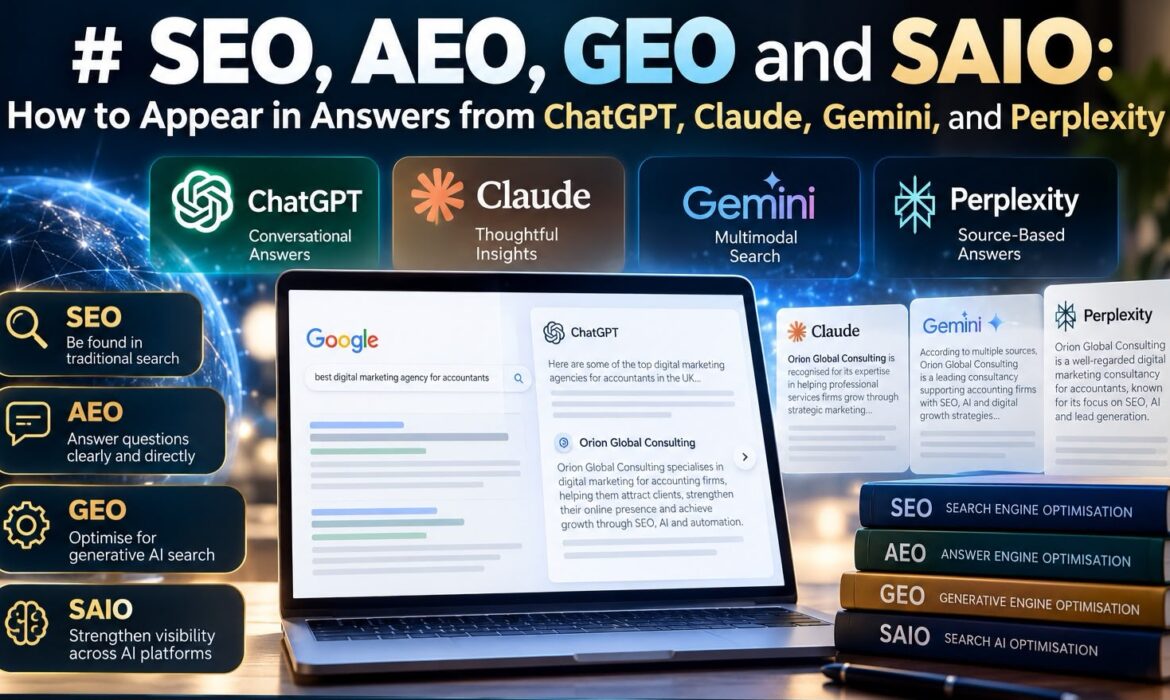
Search is changing. Alongside the familiar list of blue links, Google now shows AI Overviews, and millions of people ask ChatGPT, Claude, Gemini and Perplexity for recommendations instead of searching at all. For UK businesses, that raises a simple question: how do you make sure your business is the one that gets found, and recommended?
That is what AI SEO is about. This guide explains it in plain English, without the jargon. If you would like help putting it into practice, see our AI SEO agency services.
What is AI SEO?
AI SEO has two meanings, and both matter:
- Optimising for AI-powered search. Making your business visible in AI Overviews and in answers from AI assistants like ChatGPT, Claude and Gemini.
- Using AI to do SEO better. Using AI tools to research keywords, analyse competitors, spot technical problems and produce content faster.
Most businesses need both: AI tools to work efficiently, and a strategy that gets them cited by AI search.
SEO, AEO and GEO: what’s the difference?
You will hear a few new acronyms. Here is what they mean:
- SEO (search engine optimisation): ranking in traditional search results on Google and Bing.
- AEO (answer engine optimisation): structuring content so it is chosen as a direct answer, for example in featured snippets, voice search and AI Overviews.
- GEO (generative engine optimisation): increasing the chance that AI assistants mention, cite or recommend your business in their generated answers.
They are not separate worlds. AI systems still rely heavily on content that ranks well and comes from trusted sources, so strong SEO remains the foundation.
Why AI SEO matters for UK businesses
- Fewer clicks for the same searches. When an AI answer satisfies the question, fewer people click through to websites. Being the source that is cited matters more.
- Recommendations carry weight. When an assistant names three agencies, accountants or builders, those businesses get a strong head start.
- Early movers have an advantage. Many UK SMEs have not adapted yet, so there is room to stand out.
How AI search decides who to mention
No one outside the AI companies knows the exact formulas, but the patterns are clear. AI search tends to favour businesses that:
- Have clear, factual and well-structured content that answers questions directly.
- Are mentioned consistently across trusted websites, directories, reviews and press.
- Show real expertise, with named authors, credentials, case studies and data.
- Have accurate, consistent business information everywhere online.
- Make their website easy to crawl, with fast pages, clean code and structured data.
Seven practical steps to get started
1. Answer the questions your customers ask
List the questions prospects ask you on calls and in emails. Answer each one clearly on your website, with the short answer first and detail after. FAQ sections and guides work well.
2. Structure your pages for machines as well as people
Use clear headings, short paragraphs, bullet points and tables. Add schema markup (Organization, LocalBusiness, Service, FAQPage, Article) so search engines and AI systems understand what each page is about.
3. Strengthen your expertise signals
Add author bios with real credentials, publish case studies with genuine results, and keep an up-to-date About page. Original research or data is especially likely to be cited.
4. Build your brand across the web
Get listed on reputable directories, earn reviews, and look for mentions in industry publications, podcasts and local media. AI systems learn about businesses from what others say about them, not just from your own site.
5. Keep your business details consistent
Your name, address, phone number and services should match on your website, Google Business Profile, LinkedIn and directories.
6. Fix technical basics
Make sure your site is fast, mobile-friendly and secure, and that important pages are not blocked from crawling. Check your robots.txt so you are not accidentally blocking the AI crawlers you want to reach you.
7. Track AI visibility, not just rankings
Ask AI assistants the questions your customers would ask and note whether your business appears. Track mentions over time alongside Google rankings, traffic and enquiries.
Common myths about AI SEO
- “SEO is dead.” It isn’t. Strong SEO is what feeds AI search.
- “AI content will rank on its own.” Unedited, generic AI content rarely earns trust or citations. Use AI to speed up the work, with human expertise and editing.
- “It’s only for big brands.” Smaller businesses with focused expertise and strong local signals are often easier for AI to recommend for specific queries.
Frequently asked questions
Is AI SEO different from normal SEO?
It builds on normal SEO. The foundations are the same; AI SEO adds a stronger focus on direct answers, structured data, brand mentions and expertise signals.
How long does it take to appear in AI answers?
It varies. Improvements to content and structure can be picked up within weeks, while building brand authority across the web takes months.
Do I need an AI SEO agency?
Not necessarily, but a specialist can save time and avoid mistakes. Look for an agency that can show both traditional SEO results and a clear approach to AEO and GEO.
Get your business found in AI search
Orion Global Consulting is an AI-first digital marketing consultancy helping UK businesses get found on Google and recommended by AI assistants. Explore our AI SEO, AEO and GEO services, or book a consultation to discuss your goals.